Desert Heat Composite Deck Upgrade Costs: Azek vs. Trex vs. TimberTech
If you are pricing a desert heat composite deck for a Henderson backyard, the brand question comes up fast: Azek, Trex, or TimberTech. All three make boards that hold up in Mojave sun, but they sit at different price points and handle surface heat differently. This FAQ walks through the real cost logic, line by line, covering Azek vs. Trex cost considerations and other key factors, so you can build a budget before you request quotes instead of hitting the "call for estimate" wall every other site puts up.
How do Azek, Trex, and TimberTech compare on price?
Azek, Trex, and TimberTech each sell decking in good-better-best tiers, and the tier matters more than the brand name. Entry-level composite from any of the three costs less per board than the premium capped lines, and the premium lines are where the heat-management and fade-resistance features live. For a Henderson project, most homeowners end up comparing the mid and upper tiers. Understanding the Azek vs. Trex cost difference helps shape your material selection.
Here is the short version of how the three stack up:
- Trex builds capped composite with a wood-fiber core. Its upper tiers include lighter, heat-managing color options, and its entry tier is often the lowest-cost way into composite.
- TimberTech sells both capped composite and capped polymer (PVC) lines, so it spans the widest price range of the three.
- Azek is TimberTech's all-PVC line. No wood fiber in the core means better moisture and heat behavior, and it sits at the top of the price range.
Expect the material-only gap between an entry composite board and a premium PVC board to be meaningful, often the single biggest line-item swing in your quote besides square footage.
Why PVC costs more than composite: Azek versus Trex
PVC decking like Azek costs more because the board is all polymer, with no wood fiber to absorb heat, hold moisture, or fade unevenly. In a desert climate, that buys you a surface that sheds heat faster after sunset and resists UV fade better over a long ownership window. You pay more up front for fewer hot-surface and fade complaints later.
Composite still performs well here. The honest trade-off is this: a quality capped composite in a light color, under a patio cover or pergola, can be comfortable for less money than bare PVC in full sun. Shade structure plus mid-tier board often beats premium board with no shade, both on comfort and on total Trex vs. Azek cost comparison.
Which board colors stay coolest on a desert heat composite deck?
Lighter colors stay cooler, full stop. On a desert heat composite deck, a pale gray or sand-tone board will be noticeably more comfortable underfoot than a dark walnut or espresso tone made from the same material. Color choice is free; it changes nothing on your quote, which makes it the best heat decision you can make at zero cost.
Darker boards look sharp against desert landscaping, and many homeowners want them. If you are set on a dark color, plan for shade over the main walking and seating zones. A patio cover or awning over part of the deck is a real line item, but it solves the problem the color created.
What drives the total cost of a composite deck in Henderson?
Square footage sets the baseline, but five other factors move the number more than most homeowners expect. When you do your own deck cost estimating before calling builders, work through each of these so the quotes you get back make sense instead of feeling arbitrary.
- Board tier and brand. Entry composite to premium PVC is a wide spread, as covered above.
- Railing. Railing is priced by the linear foot, and composite or aluminum railing systems can rival the decking itself on cost for a small, high-perimeter deck.
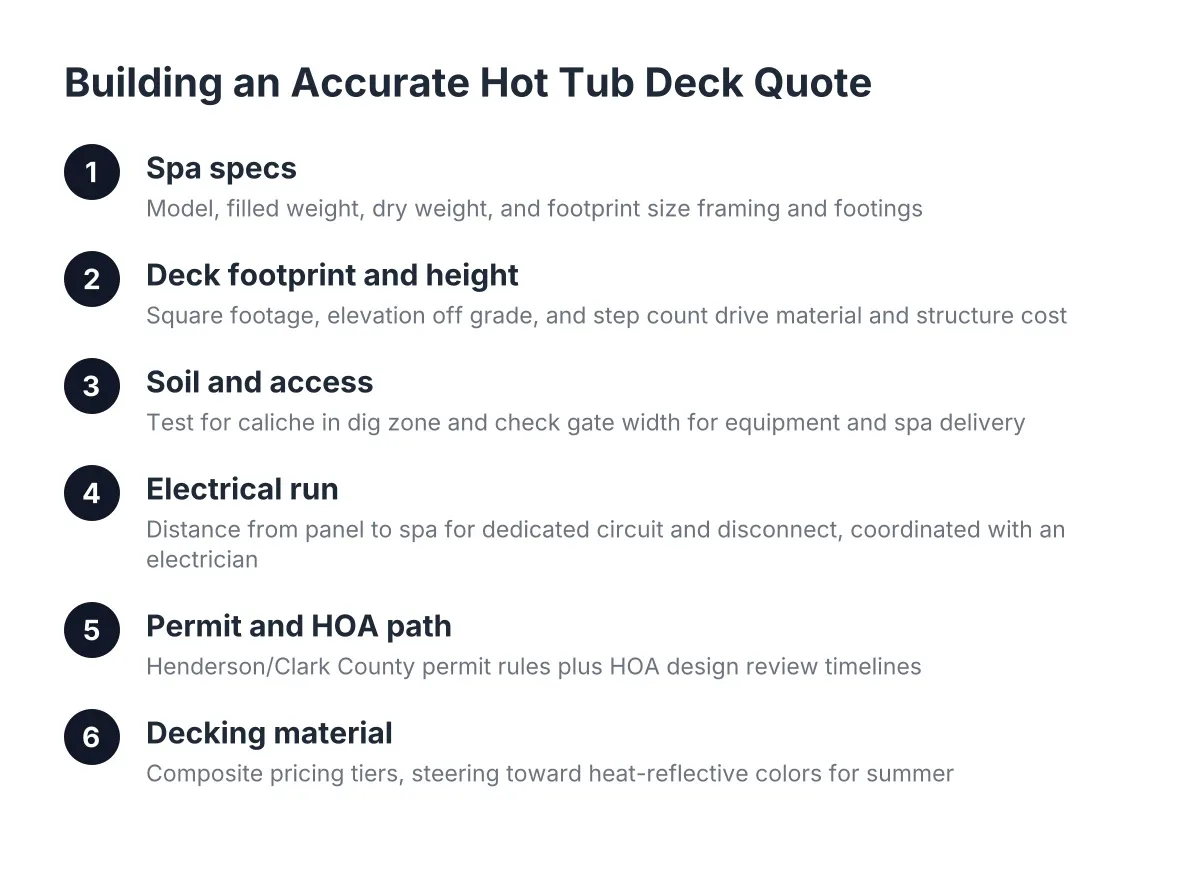
- Footings and site conditions. Henderson soil can include caliche, a hard layer that slows digging. Hitting it adds labor time to every footing.
- Height and structure. A ground-hugging platform deck costs less per square foot than an elevated or multi-level deck with stairs.
- Shade and extras. A patio cover, pergola, lighting, or a hot tub deck with reinforced framing each add their own line.
Permits through the City of Henderson and design review in master-planned communities add fees and time rather than large dollar amounts, but skipping them creates expensive problems later.
Is a desert heat composite deck upgrade worth it over keeping wood?
For most Henderson homeowners replacing an aging wood deck, composite is worth the premium because the desert punishes wood. Intense UV, dry heat, and big day-to-night temperature swings crack, cup, and gray wood boards faster than in milder climates. Composite and PVC trade a higher purchase price for years of skipped staining and sealing.
Resale math supports either path. In the 2025 Zonda Cost vs. Value Report, a wood deck addition recoups 95% of its cost at resale while a composite deck addition recoups 89%, according to Zonda / National Association of the Remodeling Industry. Wood recoups slightly more because it costs less going in, not because buyers prefer it. In a market where backyards get judged on summer usability, a desert-ready composite deck shows well.
Azek vs. Trex cost: Budget planning for material upgrades
Moving from a builder's standard composite line to a premium Azek or TimberTech PVC line typically changes only the material portion of your quote. Labor, footings, framing, and permits stay nearly the same, because the crew does the same work either way. That means the upgrade cost is smaller than the sticker gap between boards suggests.
For example, suppose a Henderson couple is replacing a cracked concrete slab with a mid-size composite deck and partial patio cover, with an overall budget in the $25,000 to $40,000 range. In that illustrative scenario, stepping from mid-tier Trex to Azek PVC might shift the total by a few thousand dollars, not double it. Ask every bidder to price the same deck design in two board tiers so you can see the real delta when comparing Azek vs. Trex cost options.
Do I need a permit or HOA approval for a composite deck upgrade?
In most cases, yes to at least one and often both. Henderson and Clark County have permit paths for decks and attached patio covers, and the trigger depends on height, attachment to the house, and whether a cover is involved. As of 2026, plan on the permit process as a standard part of the project timeline, not an optional extra.
In addition, master-planned communities around Henderson run their own design review for anything visible from neighboring lots. Submit the HOA application early; it usually takes longer than the city side. A deck builder who works these neighborhoods regularly can tell you which drawings each review board expects, though approval outcomes always rest with the HOA, not the contractor.
What should I ask builders when comparing composite deck quotes?
Ask every builder for the same breakout so quotes compare cleanly. Request the decking line item by brand and tier, railing priced separately by linear foot, footing and framing costs, and permit fees listed on their own. A quote that lumps everything into one number hides exactly the information you need.
Two more questions separate a deck specialist from a general contractor with a deck page. First, ask what board color and shade combination they recommend for full western sun in your yard; a builder who works in this heat will have a specific answer. Second, ask how they handle caliche if they hit it during footing excavation. For complex sites, sloped yards, or structural questions around a hot tub deck, have a qualified local professional evaluate the site before you lock in a budget.
If you need deck construction, Henderson Deck Co can help.
Prefer to talk it through? Call (725) 425-5179 — a quick call is usually the fastest way to get a straight answer for your situation.